Sunday, May 2, 2010

Astonishing Paper Illustration by Yulia Brodskaya

Yulia Brodskaya is an artist and illustrator born in 1983 in Moscow - Russia. She is very recognized for her astonishing, elegant and detailed paper illustrations. Currently based in the UK, where she went to continue her education in art at the University of Hertfordshire with a Master of Art in Graphics Communication degree in 2006. After getting her degree, Yulia continued to experiment and explore ways of bringing together all the things she likes most: typography, paper, and highly detailed hand-made craft objects. She has swiftly earned an international reputation for her innovative paper illustrations and continues to create beautifully detailed paper designs for clients all around the world.

"Typography is my second love, after paper and I'm really happy that I've found a way of combining the two. Having said that, I don't want to exclude non-typobased designs, I'd like to work on different projects." Yulia for Computer Arts

I bumped into Yulia's work during one of my explorations looking for inspiration and was impressed by her pieces. The colors, details, swirls and the movement of her artworks, everything matches perfectly catching our attention and enchanting those who love the combination of creativity, talent and unique ideas. Well, enough said is time for you to enjoy the images! And don't forget to visit her website for more. Hope you like it! Enjoy. =)

Astonishing Paper Illustration by Yulia Brodskaya

Astonishing Paper Illustration by Yulia Brodskaya

Astonishing Paper Illustration by Yulia Brodskaya

Astonishing Paper Illustration by Yulia Brodskaya

Astonishing Paper Illustration by Yulia Brodskaya

Astonishing Paper Illustration by Yulia Brodskaya

Astonishing Paper Illustration by Yulia Brodskaya

Astonishing Paper Illustration by Yulia Brodskaya

Astonishing Paper Illustration by Yulia Brodskaya

Astonishing Paper Illustration by Yulia Brodskaya

Astonishing Paper Illustration by Yulia Brodskaya

Astonishing Paper Illustration by Yulia Brodskaya

Astonishing Paper Illustration by Yulia Brodskaya

Astonishing Paper Illustration by Yulia Brodskaya

About the author

Someone with a bachelor degree in Foreign Trade that really likes technology, design, photography and creativity. A person 'digging' a new way as a 'geek apprentice', blogger 'wanna be' and a communication lover! Current location: Porto Alegre, RS – Brazil
Twitter user: gismullr

Sponsored Links:


Sent from James' iPhone

YouTube turns 5: See 10 of the most-watched sci-fi clips EVER

YouTube turns 5: See 10 of the most-watched sci-fi clips EVER

Do you remember the elephants? If you don't, then you weren't there that day five years ago last week, when Yakov Lapitsky uploaded the first clip to a video-sharing website—19 seconds of the elephant cage at the San Diego Zoo—and YouTube was born.

It wasn't the most thrilling clip in the world. But luckily, YouTube has gotten a lot more exciting since then.

It's also gotten a lot more sci-fi.


Sent from James' iPhone

Fat Americans are a national security threat, warn generals

Soaring rates of obesity mean more than a quarter of young Americans are now too fat to join the military, former generals warn.


Sent from James' iPhone

Animated panorama of a stadium implosion -- from the inside!

Mack sez, "This is easily the single coolest video you will watch all month: Immersive Media captured the controlled-implosion death of the defunct Texas Stadium on video that can be viewed as a full 720-degree Quicktime VR. Spin around as the charges go off and the roof collapses around you. Giddy fun."

Stadium implosion video/QTVR (Thanks, Mack!)


Sent from James' iPhone

Living Paintings: Reverse Trompe L’Oeil by Alexa Meade

[ By Steph in Graffiti & Drawing, Urban & Street Art. ]

There are many immensely talented artists out there who go to great lengths to make their paintings look as realistic as possible, mimicking the nuances of three-dimensional form, texture and lighting. But it's rare that the opposite is true – wherein an artist seeks to make reality look like a painting. Meet Alexa Meade, who paints subjects not on canvas but right on top of themselves.

Meade's thick acrylic brushstrokes turn living subjects into exaggerated, flat, painterly versions of themselves that are so accurately rendered two-dimensional, it's difficult to tell immediately that there's a real person under all that pigment. When the subject's environment is painted as well, the effect is so complete that onlookers are stunned when what looks like some kind of painted sculpture suddenly moves and breathes.

"My painting technique pushes the boundaries of perception, compressing 3D space into a 2D plane and effectively blurring the lines between art and life," Meade told Juxtapoz in a recent interview.

"Typically, when you look at a painting, you're looking at an artist's interpretation of the subject painted on canvas. In my artistic interpretation of the subject, I paint directly on top of the subject I am referencing rather than using canvas. Essentially, my art imitates life – on top of life. For example, with Portrait of a Self-Portrait you are simultaneously looking at a portrait I painted of myself, a photo I took of myself, and at me."

Meade didn't go to art school – in fact, she graduated from Vassar College with a degree in political science. When asked if her background in politics has influenced her art, she explained slyly, "My projects spin reality."


Want More? Click for Great Related Content on WebUrbanist:

Painted Alive: Boldly Brilliant Body Paintings

Craig Tracy is dedicated to creating surreal moments in time. Without the use of digital manipulation or photographic tricks, he creates dazzling body painting compositions that have elevat... 1 Comment - Click Here to Read More »»


Hyper-Realistic Wall Paintings by David Jon Kassan

If you were to round a corner in a building you thought empty and come face-to-face with one of these figures, you might experience a moment of heart-thumping fear before realizing that there's nob... Click Here to Read More »»


Share on Facebook [ WebUrbanist - By Steph in Graffiti & Drawing, Urban & Street Art. ]

Become a Fan on Facebook


Sent from James' iPhone

How to tie a sheepshank

640px-A-finished-sheep-shank.jpeg

Were you down at the archery range when your scoutmaster showed you how to tie a this handy knot? Wikihow shows you the moves.

The sheepshank is a useful knot for two purposes. It can be used to temporarily shorten a rope or it could be used to allow a rope with a damaged or frayed part to be still used (the damaged part would be in the center, where there is no tension). One of the properties of this knot is that it can get easily undone without tension, so to keep it in place, tension needs to be applied on both sides of the knot.

More:

Read more | Permalink | Comments | Read more articles in Something I want to learn to do... | Digg this!


Sent from James' iPhone

Auto-opening trash can made from Ikea junk

auto_open_garbage_can.jpg

I like the sentiment behind this build by Ikea hacker mcquarris. Using a bunch of leftover parts from previous furniture acquisitions, they cobbled together this garbage can mount to hide a trash can under their sink, complete with lid that lifts when you open the cupboard. It reminds me of some contraptions I made when I was a kid, except with much better style. Well done!

Read more | Permalink | Comments | Read more articles in Furniture | Digg this!


Sent from James' iPhone

Miracle man survives without food for 70 years

Survival of a Hindu ascetic, claimed to be not taking food or water and not passing stool or urine for over 70 years, has baffled the medical fraternity and now defense experts are studying about the miracle man to emulate the practice for soldiers.


Sent from James' iPhone

IED in NYC?

hurt.jpg

"The Hurt Locker, New York City edition." Related NYT story. (Image: screen capture from NYC local CBS affiliate WCBS-TV. Tim Shey, via @antderosa)


Sent from James' iPhone

What kind of cheese is used in Japanese bentos?

I try to make every effort to explain what the very Japanese ingredients are in Japanese bentos and recipes. But this comment by Sophie made me realize that even ingredients that may seem familiar in principle, may be a bit of a mystery when they are used in bentos. Here's her question:

..when I saw the parmesan cheese in the bento, I just had to ask: Americans (especially me!) love cheese. We put it on everything we can. Usually it's American cheese, or cheddar or mozzarella. I have a couple recipes from bento cookbooks that say to use a "slice of cheese" like in rolled up tamago or hampen and cheese. What kind of cheese are they expecting me to use? Is there a Japanese favorite? Or did these cookbooks just make these recipes up to appeal to the American obsession with cheese?

The short answer is: no, the cheese reference is not just there for Americans - Japanese people love cheese too. When just 'cheese' is specified in a Japanese cookbook, it usually means presliced, processed cheese, just like the kind you get in the U.S. and elsewhere, individually wrapped in plastic. Japanese sliced cheese is a bit firmer than American sliced cheese, but you can use American sliced cheese in the same way.

Delving into the history of cheese in Japan a bit may clarify things further. While there is historical evidence of a cheese-like curd product having been made and eaten in Japan as early as the 12 or 13th century, serious cheese production only started in the 1930s or so. At the time, Japanese people were not familiar with the texture or flavor of cheese, so cheese manufacturers like Yukijirushi or "Snow Brand" (who is still a major manufacturer of cheese and dairy products) made cheese that resembled foods that were more familar, like kamaboko (firm fish paste cake). The standard processed cheese sold by Yukijirushi didn't even melt when heated - it softened a bit, but retained its shape (rather like haloumi cheese does). A second type of processed cheese was specifically sold as 'cheese that melts', for use on pizza, cheese on toast, and the like. (I remember these cheese types being sold when I was a kid, but I don't think they are sold anymore.)

Nowadays, all kinds of cheese are available in Japan, both imported and made domestically - though imported cheese is terribly expensive. When it comes to bentos though, usually only processed cheeses are used. The way presliced cheese is used in charaben is really similar to the way other firm yet easy to cut products, like kamaboko, hanpen (a puffy light fish paste product made from fish paste and whipped egg whites), ham, wiener sausages and fish-paste or gyoniku sausage.

Another type of processed cheese product that makes its way into bentos is 'candy cheese'. This is just little chunks of processed cheese that are individually wrapped to look like candy - and thus theoretically appeal to picky-eater kids. I've even seen these featured prominently in a translated-to-English bento book. As far as I know 'candy cheese' is not available outside of Japan (unless it's available in other Asian countries?)…so I can imagine the 'candy cheese' confusing quite a few readers of that book.

The last type of cheese that may appear in a bento cookbook is kona cheezu or 'powdered cheese'. This is the pre-grated stuff that comes in a green canister. (Yes, this is the era of multinational brands.)

Of course, in your bentos you can use any cheese you like. Personally I prefer to stay away from processed cheese, purely for taste reasons.

Cheeses suitable for cutting into shapes

If for some reason you can't get a hold of malleable presliced processed cheese, but want to make cheese cut-outs and such for your bentos, I've tried the following cheeses with varying degrees of success:

  • Gouda - has the required elasticity and firm texture for making intricate cuts and such
  • Provolone - similar to Gouda in texture, and works equally well
  • Jack (aka Monterey Jack) - a bit soft, but can work if used straight out of the refrigerator.
  • Emmentaler or 'Swiss' cheese - also has the right texture, though those big holes can get in the way
  • Gruyère - A bit more crumbly, but can work for simple cuts (Comté is very similar to Gruyere). Younger Gruyères are easier to handle - the older (more aged) it is, the more crumbly it gets.
  • Cheddar - Even more crumbly and oily than Gruyère, but can be used for simple cuts. Sharp edges may break off.

Incidentally, while Japanese people probably don't eat as much cheese as Americans, I'd actually rank the American fondness of cheese below that of most European nations. There is a blog called Chez Loulou, whose owner Ms. Loulou is attempting to eat every French cheese there is in existence. She's almost up to no. 170, but still has a long, long way to go! In Switzerland, it's not at all uncommon to just have cheese and bread or potatoes for dinner, and there's also fondue and raclette. (We once served a meal consisting just of several varieties of cheese, with wine and bread, to an (older) American friend who was visiting. He later confessed that up until then he would have never dreamed of just having cheese and bread for dinner - to him that was a 'poor person's meal'!) There are tons of local cheeses in Italy, Spain, the UK… and on and on.

Do you like to use cheese in your bentos - and if so, what are your favorites, and how do you use them?


Sent from James' iPhone

Are Likes and Retweets the New Links?

Search has been evolving for years, and it looks as though its really starting to enter a new era entirely. While search and social media may be two different animals, it is becoming more clear that they're directly related, and will continue to be more mixed into one another.

We're already seeing search engines attempt to place some kind of ranking on social updates. For example, we've already know that search engines take things like follower quality into account in how they rank tweets (see more on that from Google and Bing).

There has been a lot of talk of Facebook "likes" and Twitter retweets taking the place of links. Nobody's saying that links are dying exactly. There is obviously plenty of room for link sharing on either of these services, but in some ways these kinds of sharing are replacing links in many cases. Before Facebook even announced its plans to take over the web, WebProNews talked with Rand Fishkin of SEOMoz about how Twitter is "cannibalizing the Web's link graph":

Now that Facebook's Open Graph and social plugins are devouring the web, suddenly liking is taking the place of linking in some speculative scenarios. We talked about some implications Facebook's initiatve has for search in a recent article.

While I dont' think anyone specifically saw the Open Graph stuff coming too long before it was announced (maybe somewhat in the days leading up to it), it's really still reflective of what we've known for some time. The way people are obtaining information online is diversifying. I feel like I'm beating a dead horse (as I've written about his repeatedly, but it's just what the big picture is about. Google's real competition isn't coming from other search engines. It's coming from different avenues of information access.

The biggest threat to Google the search engine (as opposed to the company, which offers a lot more) is people not having to rely on the traditonal search engine. While I don't think Google has anything to truly worry about in terms of losing users, it has to worry more about users just not using it as often, because they're getting their information from apps...from friends via social networks...even when they're not necessarily at Facebook.com itself, but on any given site or app, via things like social plugins (Twitter has its own @anywhere platform, and we'll probably see more ways networks are penetrating sites. Hell, Google already has its Friend Connect and Buzz...I would not count the company out in expanding into more of this kind of stuff).

Style Coalition CEO Yuli Ziv has an interesting article at Mashable about "5 reasons Google and Search wont' Dominate the Next Decade". Her reasons include:

1. The search process is inefficient
2. Mobile GPS Eliminates the need for location-based search
3. Social Matching Could Create Valuable Connections
4. Content Recommendations to Replace Search
5. Suggestions Will Be the Core of Our Shopping Experience

She elaboraates on each of these of course, and some of them are debatable, but really, the diversification of how people obtain information has already begun.

Facebook likes may not translate to better Google rankings, but so what? They may translate to a better Facebook ranking. After all, the more people that "like" you brand, the greater the visibility within Facebook. With over 400 million users and counting, and Facebook expanding its presence, that means more visibility period, and at a more meaningful level of personalization. It's not about choosing between likes and links. Both are ideal.

WebProNews recently stopped by comScore's New York offices, and had a chat with search evangelist Eli Goodman who made some good points about where search is headed, and how not only the technology of search engines changes over time, but the habits of users, and the relationship between the two.

As far as optimizing for search, it seems pretty clear that social and mobile will continue to play larger roles. It also seems clear that if you want social success, you need to work at your relationships with others within your networks. Look at Twitter's Promoted Tweets strategy around "resonance." Look at tools like Trst.me, which uses a PageRank-like strategy to score Twitter users.

Look at the implications of Facebook likes. Regardless of what Facebook chooses to do with this data itself, they're already being utilized in other places, like in search via OneRiot. The whole point of Facebook's Open Graph is to connect the web. It stands to reason that Facebook likes will be of influence in plenty more places.

The point of all of this is, it's not just about getting links anymore. Links will always be of use, but social interactions may equal them in importance, and in some cases may be of greater use to your visibility, and ultimately getting people to your site, your content, your store, or your shopping cart.


Sent from James' iPhone

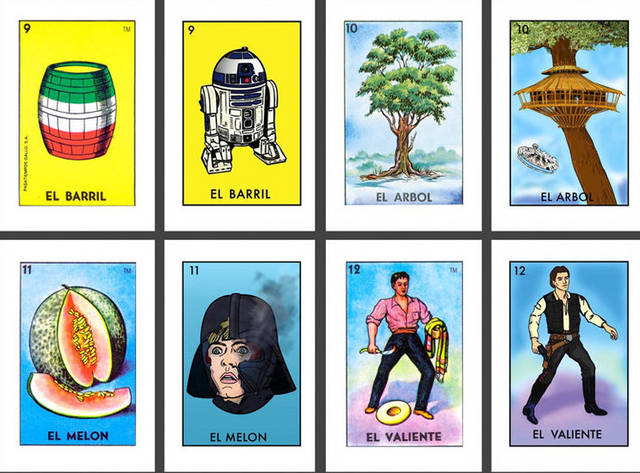
Star Wars Loteria tribute


Artist Chepo Peña created a wonderful Star Wars-based tribute to the cards from the Mexican Loteria card-game.

Star Wars Loteria (Thanks, Fipi Lele!)


Sent from James' iPhone